Tainure
Know the personCarry the context
I founded Tainure and am building it end to end: product direction, design, AI workflows and engineering. It helps managers and individual contributors turn everyday notes into a useful memory of the people they work with, so the next conversation starts with context.
Visit Tainure (opens in a new tab)Explore the product and request a private beta invite
Too much context to keep in your head
Managers now coach and grow more people than before, and most still do hands-on work of their own. The goals, promises and small signals from each conversation end up scattered across notes, so every 1:1 starts by rebuilding the story.
Founder, from idea to implementation
This is my independent product. I own the product direction, interaction design, visual system, AI workflows and application development, carrying decisions through from the first sketch to the working experience.
Building in private beta
Tainure is an active project in private beta, with invitations released in small batches. I am continuing to develop the experience for managers and individual contributors.
Bigger teamsStill hands-on
Teams are growing as organisations remove management layers, and nearly every manager still carries individual work. I know this first-hand as a design manager who still ships, and it is why I built Tainure.
12.112.1direct reports for the average US manager in 2025
Up from 10.9 in 2024. The median is still five to six; a rise in very large teams lifts the average.
Gallup, 2026 (opens in a new tab)42%42%of organisations cut management roles over the past year
And 55% of the managers who remain say they are exhausted.
Korn Ferry, 2026 (opens in a new tab)97%97%of US managers also carry individual-contributor work
The median manager spends 40% of their time on it.
Gallup, 2026 (opens in a new tab)30%30%of leaders feel they have enough time for their responsibilities
From 10,796 leaders in more than 50 countries.
DDI, 2025 (opens in a new tab)From what was saidto what comes next
Capture a conversation once. Use its context in the next 1:1, a coaching question or a follow-up months later. These scenes from the product film use fictional people and notes.
Give everyday notes a memory
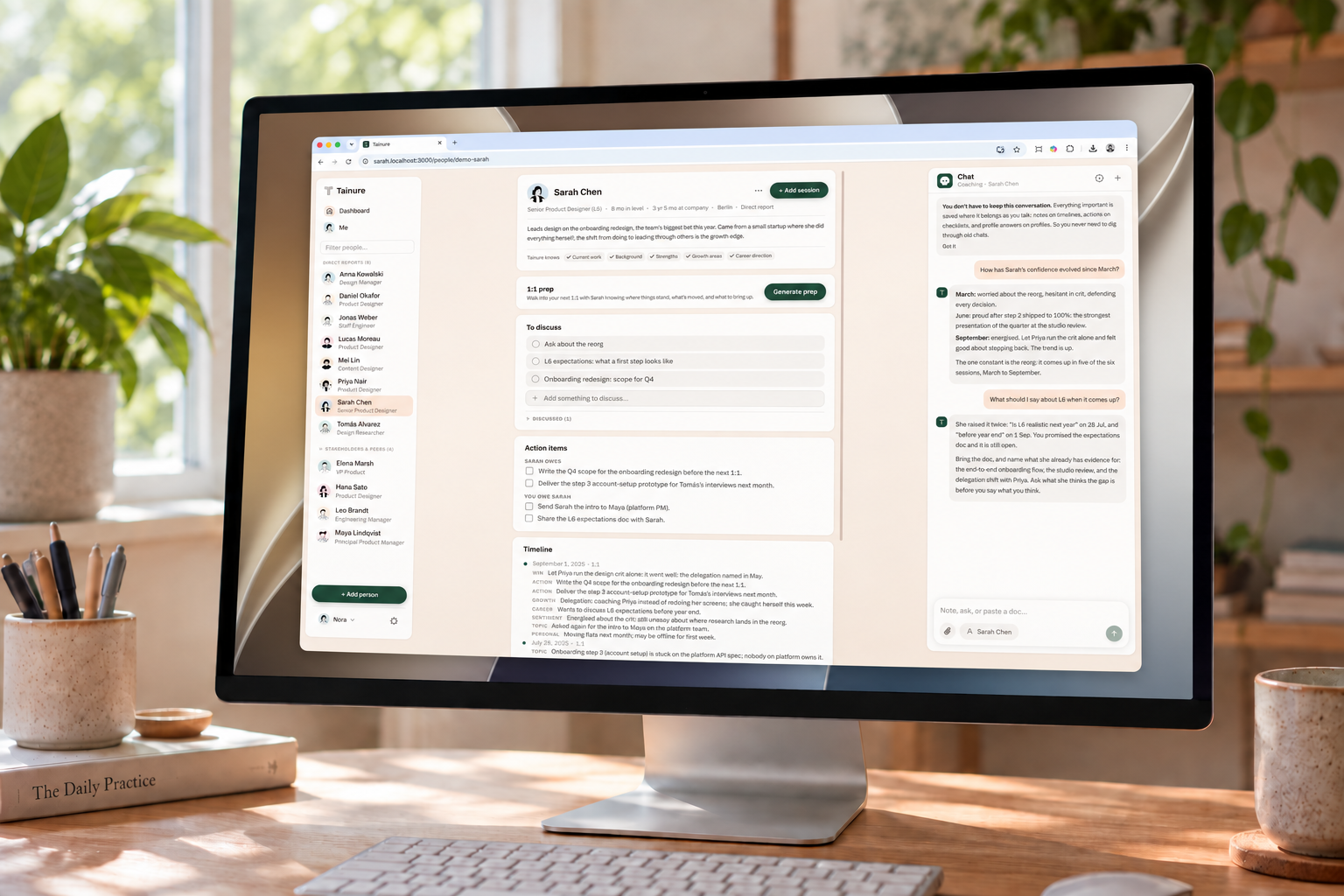
Paste the notes you already take. Tainure keeps what was said, what you owe and what to raise next, filed on the page of the person it is about.
Product film: pasted notes become what was said, what you owe and what to raise next. Pick up where you left off
Before each 1:1, the prep brings back what is still open with that person: a question, a promise, a topic to raise. Moving from one conversation to the next starts with context, not a blank page.
Product film: three 1:1 preps, each showing what is still open. Coaching that starts from what happened
Any assistant can offer tips. Tainure answers from your dated notes and a library of coaching approaches, and ends on something you can say in the next conversation.
Product film: the answer about Daniel cites three dated notes and the approach it draws on. Keep feedback in the conversation
Feedback given in May is still there in October, next to what happened since, so it becomes an ongoing conversation rather than a one-off.
Product film: feedback from May, followed on Sarah's timeline through October. The same memory from the other chair
Individual contributors use Tainure for their peers, stakeholders and manager: a prep that is ready when their manager asks, and a last review turned into next steps.
Product film: Sarah's own Tainure, with her last review turned into next steps.
One productEvery layer connected
Building Tainure myself lets me carry the same intent through the experience, the design system and the implementation.
Start with an existing habit
The entry point is the notes someone already takes after a conversation. The product adds structure and continuity around that habit, then makes the captured context available when it becomes useful again.
Connect memory to a useful next step
A stored note is only the beginning. Preparation, open commitments, questions and coaching all draw on the same relationship history, so an answer starts from what actually happened rather than generic advice.
Keep the workspace personal
Tainure is designed around a person's own working relationships. Each workspace has its own database, notes are never used to train AI, and product analytics exclude note content. Privacy is part of the product structure.
A working productStill evolving
This is an ongoing founder project. The current milestone is a working private beta that brings the core experience together.
From concept to a working beta
Notes, relationship history, meeting preparation and contextual coaching come together in one personal workspace.
Built for both sides of a conversation
Managers can follow their team's context. Individual contributors can keep track of peers, stakeholders and their own manager, and prepare conversations about their growth.
Founded and built end to end
I continue to develop Tainure across product strategy, design and engineering, with the public site introducing the experience and inviting people into the beta.